

The Secret to Making Your Home Feel Softer: Curves Instead of Corner
- Mar 16
- 3 min read

Most HDB homes are defined by straight lines. Walls, cabinets, and built-ins typically follow rigid right angles, practical for construction, but visually they can make spaces feel structured or even slightly harsh.
In this Tampines HDB apartment, the design explores a different approach: using curves instead of corners to soften the overall spatial experience.

Curves have long been used in architecture to influence how people perceive and move through space. Unlike sharp edges, rounded forms create a sense of continuity.
The eye naturally follows curved lines, which makes a room feel more fluid and visually calm. In smaller homes such as HDB apartments, this subtle shift can have a noticeable impact on how spacious and relaxed the interior feels.
The living room introduces this design language through a curved feature wall that integrates storage and display. Instead of a typical wall of flat cabinets, the carpentry includes gently rounded transitions between shelving and cabinetry.

These curves break the rigidity of built-in storage, allowing the structure to feel lighter and more architectural rather than purely functional. Soft blue panels, open shelving, and pale wood tones layer together to create visual depth while maintaining a calm palette.

Beyond aesthetics, curved carpentry also helps reduce visual clutter. Sharp corners tend to emphasise edges and divisions, while curves allow different elements to blend together more naturally. This makes the feature wall feel less like separate pieces of furniture and more like a cohesive part of the room’s architecture.

The bedroom continues this idea of integrated design. Instead of placing a standalone headboard and dressing table, the two are designed as a continuous composition along the wall. Subtle groove lines introduce texture and rhythm, while curved edges soften the joinery.
By integrating these elements into one structure, the room feels more streamlined and spacious.
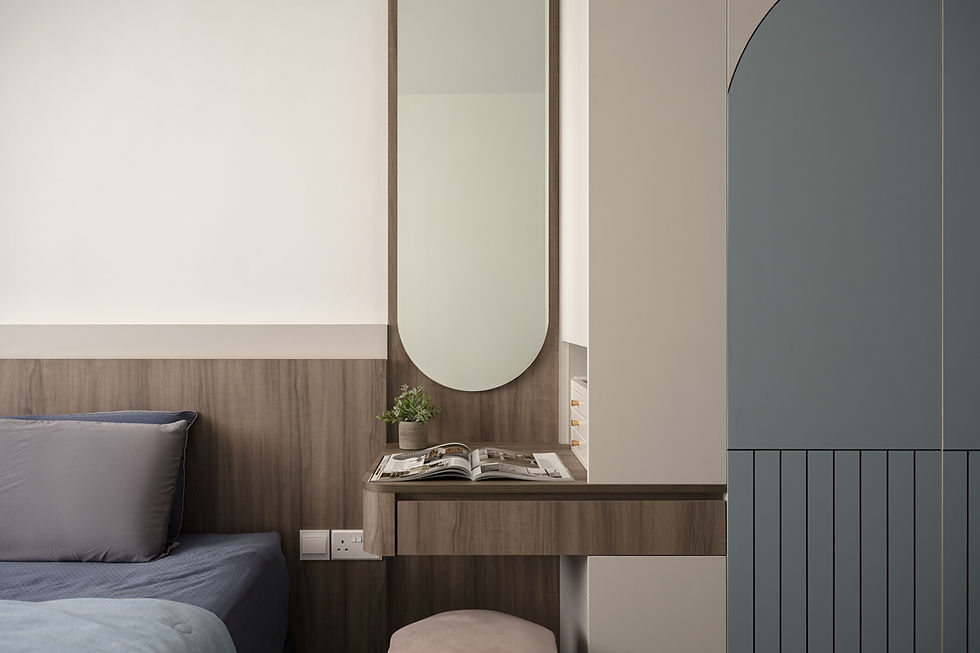
A closer look at the dressing table highlights another benefit of curved design, seamless transitions. Rather than ending abruptly at a corner, the surface gently curves into the wall, eliminating hard junctions.
This makes the piece feel almost carved into the room itself. These small design adjustments may seem subtle, but they contribute significantly to the overall sense of cohesion within the space.

In the kitchen, curves influence not just appearance but also circulation. The pantry area incorporates curved shelving that softens the vertical cabinetry while providing a place to display everyday objects.

At the centre of the room, a rounded island replaces the typical rectangular form.
Rounded islands are often used in compact kitchens because they improve movement around the space.
Without sharp corners obstructing pathways, circulation becomes smoother, especially in open-plan layouts where the kitchen connects directly to the living area.
The curved form also encourages a more social environment, allowing people to gather around the island more naturally.

Material selection supports the overall design strategy. The palette remains restrained, white cabinetry, light wood accents, and a subtle stone backsplash. This allows the shapes and forms of the carpentry to take visual focus without overwhelming the interior.
The stone backsplash in particular introduces texture, catching light throughout the day and adding depth to the otherwise minimal surfaces.

What this apartment illustrates is that softness in interior design is often achieved through geometry rather than decoration. By replacing sharp corners with gentle curves, the home feels more fluid, comfortable, and visually calm.

In compact homes where every element must serve both functional and aesthetic purposes, these thoughtful adjustments can transform everyday spaces into environments that feel more balanced and inviting.


Comments